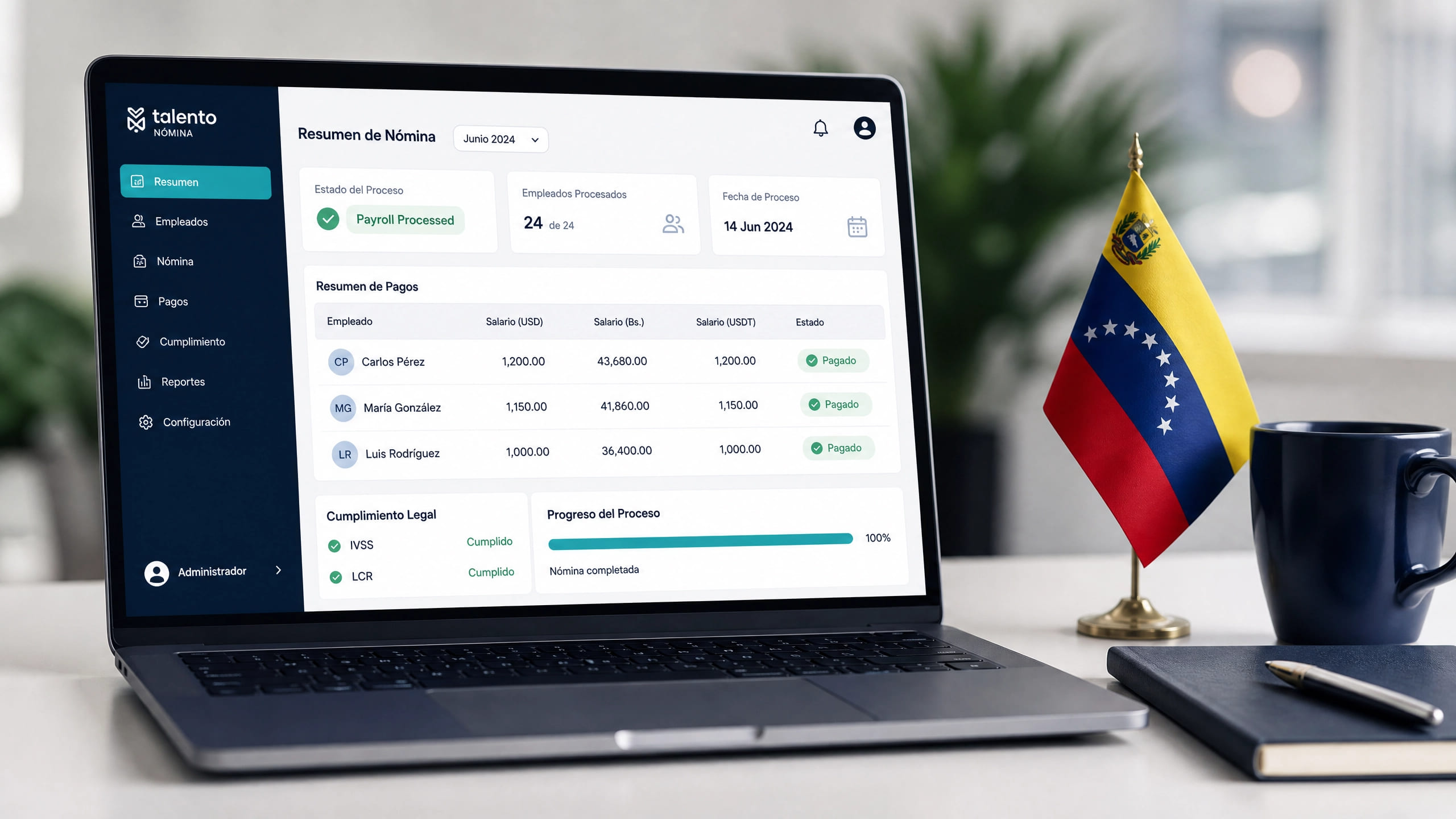
Payroll in Venezuela: How It Works for Employers
Running payroll in Venezuela means multi-currency pay, mandatory benefits, and strict deadlines. Here's what employers need to get right.
Running payroll in Venezuela involves more moving parts than most countries: a dual currency system, a set of mandatory benefits that add meaningfully to base pay, and contribution rules spread across several different government institutes. Here is how it all fits together.
Key Components of Venezuelan Payroll
A Venezuelan payslip typically includes base salary, any dollar denominated bonus or allowance, statutory deductions for social security and related programs, and, depending on the time of year, accrued or paid out benefits like the vacation bonus or the year end bonus. Employers also need to track accrued severance style benefits that build up over the course of employment, even though they are not paid out on every cycle.
Multi Currency Pay Explained
Because of Venezuela’s history of high inflation, it is standard for employers to structure part of compensation in US dollars, on top of a bolivar denominated base salary that satisfies minimum wage requirements. This dollar portion is typically converted to bolivares at the official BCV exchange rate on the day of payment for any statutory calculations, while the actual payment to the employee may be made in dollars directly or in bolivares at that day’s rate, depending on how the company has structured pay.
Mandatory Benefits and Deductions
On the deduction side, employees contribute 4% of salary to the national social security institute (IVSS), 1% to the housing fund (FAOV), and 0.5% to unemployment insurance (paro forzoso). Employers contribute a matching but larger share: 9 to 11% to IVSS depending on the company’s risk classification, 2% to FAOV, 2% to unemployment insurance, and, for companies with five or more employees, 2% to the national training institute (INCES), paid quarterly. On the benefits side, employees are entitled to a paid vacation period plus a vacation bonus, and a year end bonus (utilidades) equal to at least 30 days of salary, calculated against 15% of company profits if that yields a higher amount.
Payroll Frequency and Deadlines
Most Venezuelan employers pay salary biweekly or monthly, depending on company policy and any applicable collective agreement. Statutory contributions to IVSS, FAOV, and paro forzoso are generally due monthly, while INCES contributions are due quarterly. The year end bonus has a specific legal payment window before the end of the calendar year, and missing it can create both compliance exposure and employee relations issues.
How to Simplify Payroll Compliance
Given how many moving parts are involved, many companies, especially foreign ones without a dedicated local payroll team, use either specialized local payroll software or an employer of record to handle the calculations, currency conversions, and filings. Whichever approach you take, the core requirement is the same: apply a current, defensible exchange rate consistently, track accrued benefits accurately, and file each contribution on its correct schedule.
For the step by step version of running a single cycle, see how to pay payroll in Venezuela step by step.

Ready to Build Your Team in Venezuela?
Tell us what you need and one of our advisors will reach out within 24 hours.
All fields are required.